Why Container Growing Works for Aromatic Herbs
Most aromatic herbs native to the Mediterranean basin — sage, rosemary, lavender, thyme and oregano — evolved in rocky, alkaline soils with low organic content. These conditions are replicable in pots, often more easily than in heavy clay garden beds. French kitchen gardens, especially in Paris and Lyon, have long relied on terracotta pots and window boxes for exactly this reason.
The main advantage of containers is control: you can adjust drainage, move plants away from frost, and position them to capture the maximum sun hours on a south-facing balcony. The main limitation is volume — smaller pots dry out faster and restrict root expansion for larger shrubs like rosemary.
The minimum recommended pot diameter for perennial herbs such as rosemary and sage is 30 cm. Smaller pots restrict root growth and require watering more than once per day in summer.
Soil Mix for Mediterranean Herbs
Standard potting compost retains too much moisture for Mediterranean herbs. A suitable mix for most aromatic species includes:
- 40% standard potting compost
- 40% coarse horticultural grit or perlite
- 20% garden lime or crushed limestone (optional for alkaline-preferring species)
This mix drains quickly and prevents the root rot that kills more container-grown herbs than any other cause. For mint and chives, which prefer more moisture, a standard compost without added grit is appropriate.
Species-by-Species Notes
Sage (Salvia officinalis)
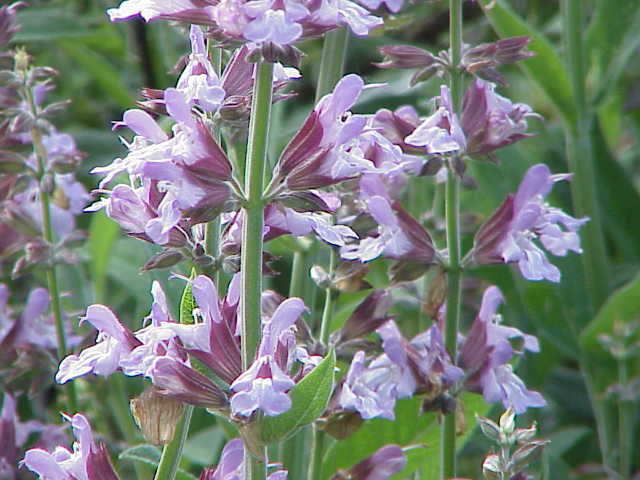
One of the most forgiving aromatic herbs in containers. Sage tolerates partial shade but produces more aromatic leaves in full sun (minimum six hours per day). Water only when the top 3–4 cm of soil is dry. Overwatering causes yellowing of leaves and stem rot at the base. Cut back by a third after flowering to prevent the plant from becoming woody too quickly.
In France, Salvia officinalis is the standard culinary sage, used in stuffings, butter sauces and with pork. The cultivar 'Purpurascens' (purple sage) is equally edible and slightly more ornamental.
Lavender (Lavandula angustifolia)
Lavender requires the most drainage of all common aromatic herbs. Use at least 50% grit in the potting mix. It does not tolerate waterlogged roots and will die back from the centre if overwatered. In France, Lavandula angustifolia — true lavender — is distinct from lavandin (L. × intermedia), the hybrid grown commercially in Provence. For container use, angustifolia varieties such as 'Hidcote' or 'Munstead' are more compact and manageable.
Rosemary (Salvia rosmarinus)
Rosemary grows into a substantial shrub if not pruned. In containers, restrict root growth by choosing a pot no larger than 35 cm and repotting only when visibly rootbound. Water sparingly in winter; most rosemary deaths in French urban gardens result from wet roots combined with cold, not from frost alone. The species is hardy to approximately −10°C when the soil is dry.
Thyme (Thymus vulgaris)
Thyme is the smallest and most compact of the common culinary herbs, making it ideal for window boxes. It can be grown in 15 cm pots without difficulty. Harvest regularly: cutting the stems back by half after flowering encourages fresh compact growth and prevents the plant becoming a tangle of woody stems within two seasons.
| Herb | Min. Pot Size | Watering | Sun Requirement | Winter Hardiness |
|---|---|---|---|---|
| Sage | 25–30 cm | Low — let dry between waterings | Full sun | Hardy to −10°C |
| Lavender | 30 cm | Very low — drought tolerant | Full sun | Hardy to −15°C (dry) |
| Rosemary | 30–35 cm | Low to moderate | Full sun | Hardy to −10°C (dry) |
| Thyme | 15–20 cm | Low — let dry between waterings | Full sun to partial shade | Hardy to −15°C |
| Mint | 20 cm | Moderate — keep soil moist | Partial shade acceptable | Hardy to −10°C |
Mint (Mentha spp.)

Mint is invasive when planted in open ground and is better suited to containers than almost any other herb. Grow it in its own pot rather than mixing with other herbs: its aggressive root spread will outcompete sage and thyme within a single season. Spearmint (Mentha spicata) and peppermint (M. × piperita) are both common in French gardens; the former is milder and used more in cooking, the latter has higher menthol content and is used primarily in teas and infusions.
Overwintering Potted Herbs in France
Northern France (Paris, Lille, Strasbourg) experiences harder winters than the south. Potted Mediterranean herbs are more vulnerable to cold than ground-planted ones because their roots are exposed on all sides. Practical measures include:
- Grouping pots together to reduce exposed surface area
- Wrapping pots in bubble wrap or hessian in December–February
- Moving tender species such as basil indoors before the first frost (basil is annual and not cold-hardy)
- Avoiding clay pots that can crack in hard frosts; opt for terracotta or plastic-lined containers
In the south — the PACA region, Occitanie, Provence — most of the herbs listed here overwinter outdoors in containers without protection.

